PROPOSED RESEARCH PROGRAM
THESIS: Understand and Engineer the Electrolyte Side of the Electrode-Electrolyte Interface in Nonaqueous Electrochemical Systems
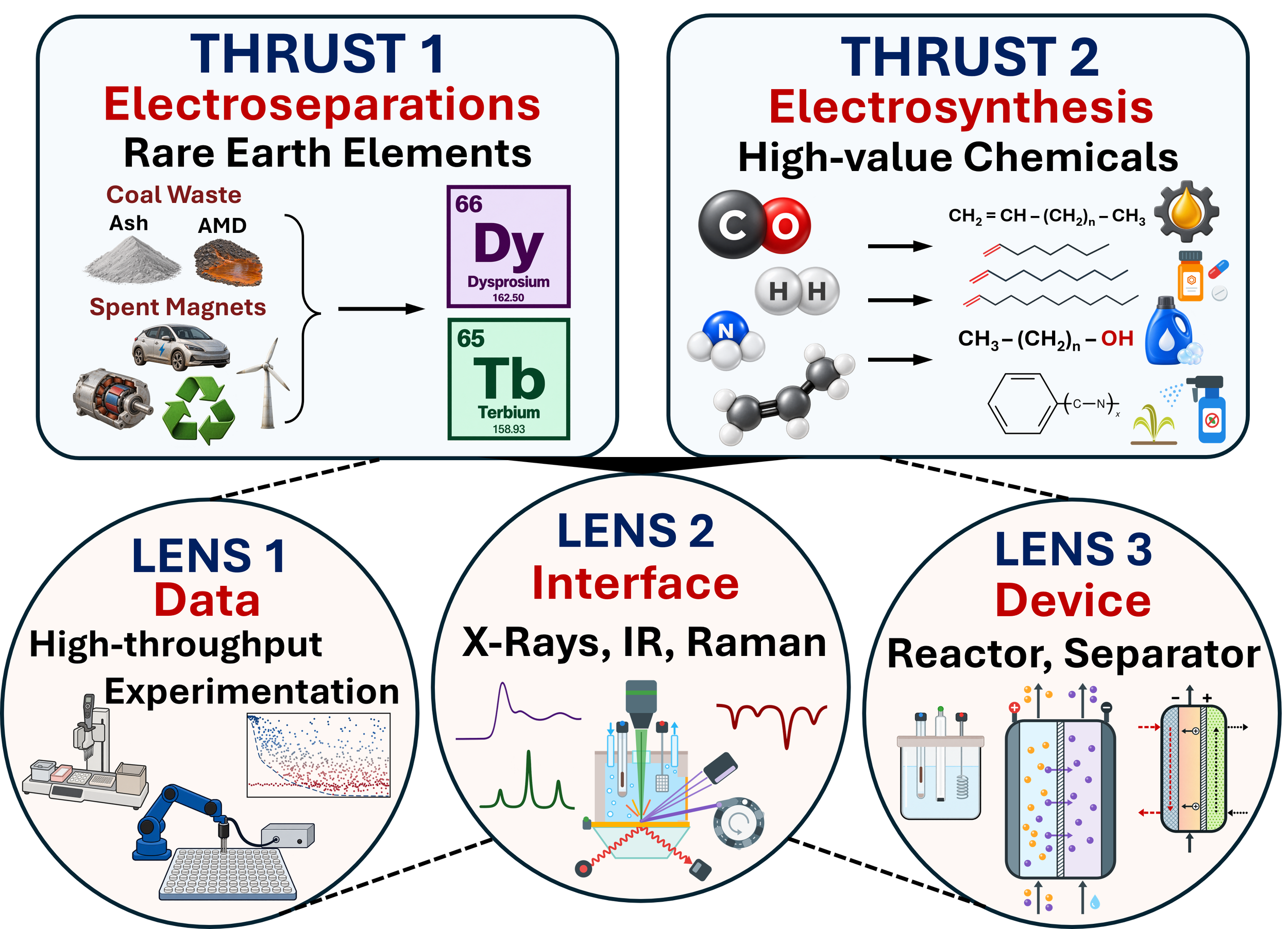
THRUST 1 (T1): Electroseparation of Rare-Earth Elements from Secondary Resources
Terbium (4600 $/kg)* and Dysprosium (2200 $/kg)* are key components of permanent magnets used in electric vehicles, wind turbines, and defense systems. Intra-lanthanide separation is one of the most challenging problems in chemical engineering because the valence shell electronic configuration and preferred oxidation states of the lanthanides are nearly identical. Current separation strategies, such as solvent extraction, rely on subtle, monotonic changes in thermodynamic properties across the series. As a result, they require hundreds of stages, which makes them energy-intensive and inefficient. In this thrust, we will develop novel electrochemical strategies to separate these critical rare earth elements. We will focus on rare earth concentrates derived from secondary domestic resources, such as coal by-products (refuse, ash, acid mine drainage, and tailings) and end-of-life permanent magnets that cannot be reused or recycled. Our initial work will target the selective separation of Tb from these concentrates, and we will later extend these approaches to Dy, Nd, and other lanthanides.
*Price outside China, Source: Strategic Metals Invest, November 2026
THRUST 2 (T2): Electrosynthesis of High Value Chemicals at Intermediate Temperatures
Chemical manufacturing relies on activating stable molecules. Thermochemical processes achieve this with high temperatures, which deliver fast rates but accelerate desired and undesired pathways alike and confine production to capital-intensive, centralized plants. Electrochemical processes offer a modular alternative in which electric potential selectively activates the desired pathways, but they have been developed largely in aqueous media below 100 °C. We will combine the strengths of thermal and electrochemical approaches, and develop electrosynthesis strategies in non-aqueous electrolytes at intermediate temperatures (100–200 °C). We will convert platform molecules and secondary building blocks (CO, H2, CH3OH, NH3, and CnH2n) into long-chain α-olefins, long-chain alcohols, and nitrogenated aromatics, which serve as precursors for plastics, lubricants, surfactants, and pharmaceuticals.
T1 and T2 will be investigated through three complementary lenses
Lens 1 (L1): Data
We will couple high-throughput experimentation with agentic AI in a closed loop, to generate large experimental datasets to train supervised neural networks for data driven discovery.
Lens 2 (L2): Interface
In situ and operando X-ray, IR and Raman spectroscopy for investigation of electrochemical interfaces.
Lens 3 (L3): Device
Device level investigations and development of reactors and separators to maximize the Faradaic efficiency, separation factor, reaction rate, stability and energy efficiency.